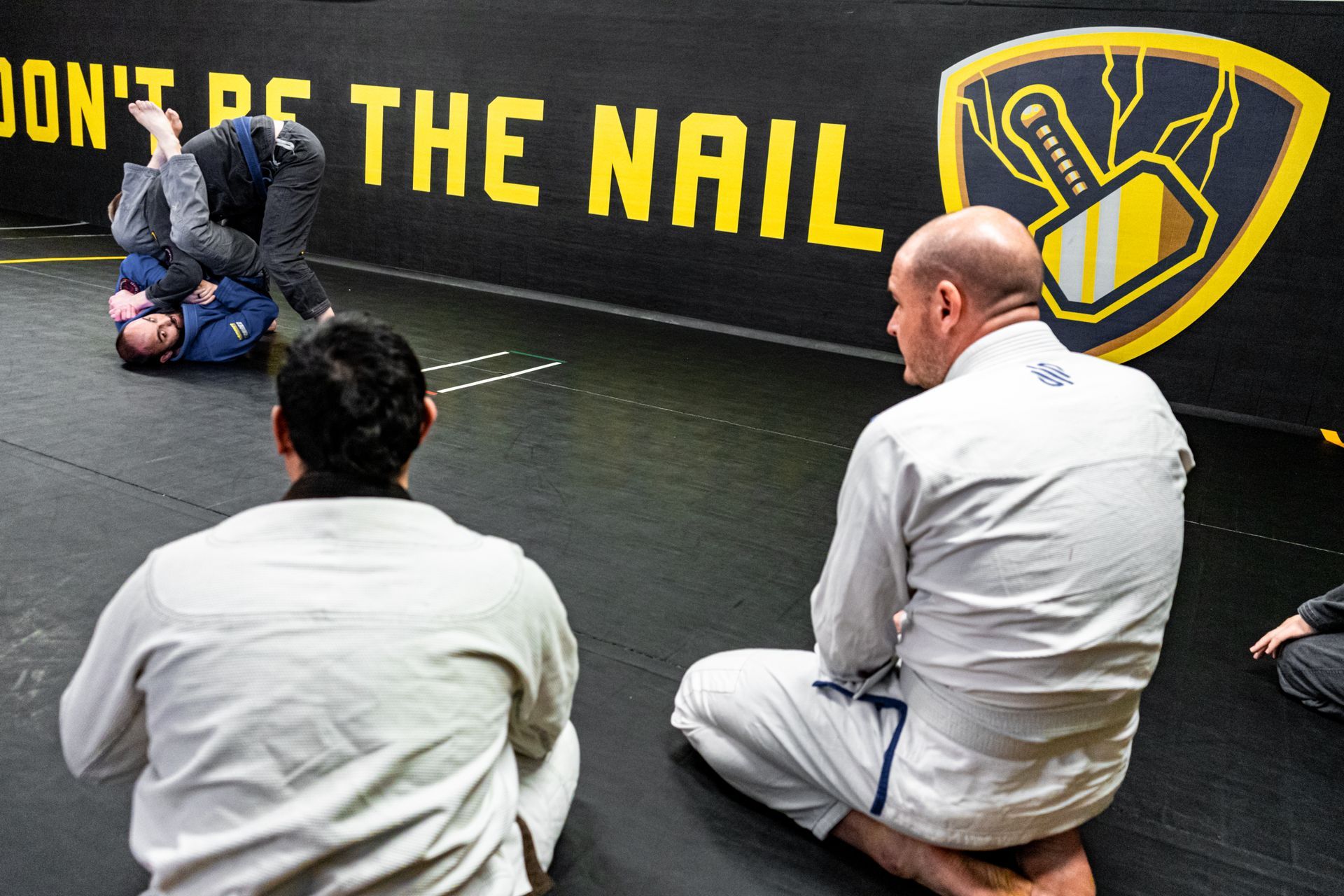
Every round on the mat is a real-time puzzle, and you get better at solving it under pressure.
Adult Jiu-Jitsu is often described as “human chess,” but that phrase only really clicks once you feel it: the constant micro-decisions, the quick resets, the calm that shows up right when your lungs want to panic. In Hazlet, where work schedules, commutes, and family obligations can make consistency tough, we’ve found that adult training needs to deliver more than a sweat. It has to build skills that carry into the rest of your week.
Our Adult Jiu-Jitsu program is built around that idea. Yes, you’ll get fitter. Yes, you’ll learn practical self-defense. But the bigger payoff for many adults is what happens mentally: improved problem solving, stronger emotional control, and the kind of resilience you can’t fake. Over time, you start handling hard situations differently because you’ve practiced doing exactly that, in a safe, coached environment.
Why Adult Jiu-Jitsu in Hazlet, NJ fits the way adults actually live
Hazlet has a small but active jiu-jitsu scene, and that matters because most people searching locally are not asking “What is jiu-jitsu?” You’re asking a much more practical question: “Can I realistically fit this into my life, and will it help?”
We design Adult Jiu-Jitsu in Hazlet, NJ for real adults with real constraints. That means beginner-friendly positioning, clear coaching, and a training culture that respects the fact that you might be managing stress, old injuries, or just a long day at work. You don’t need to be a “fighter.” You need a repeatable process you can show up for.
And because local interest tends to center on fitness, self-defense, stress relief, and community, we teach the art in a way that hits those drivers without turning classes into a vague cardio session. You’ll learn skills, not just burn calories.
Adult Jiu-Jitsu is a live problem-solving loop (and that’s the point)
If you want a clean example of problem solving under pressure, you can’t do much better than a grappling round. It’s immediate. You try something, you get feedback, you adapt.
In each round, you’re running a loop that looks like this:
1. Notice what’s happening: grips, posture, distance, pressure, timing
2. Choose a response: frame, hip escape, underhook, stand up, re-guard
3. Test it against resistance: your partner is not “letting you” do it
4. Learn from the result: you either improved position or you didn’t
5. Reset and try again: with one small adjustment, not a total overhaul
That loop builds a specific kind of intelligence: pattern recognition plus composure. You learn to see the early warning signs (your elbow drifting away, your base narrowing, your breathing speeding up) and fix them before the situation snowballs.
Over weeks and months of Adult Jiu-Jitsu, you’re not just collecting techniques. You’re training your brain to stay useful under stress.
The hidden skill: staying calm while you’re losing
A lot of adults quit new hobbies because being bad at something feels uncomfortable. Jiu-jitsu doesn’t let you hide from that discomfort, but it also teaches you how to work with it.
When you’re pinned, the goal is rarely “explode and win.” The goal is: breathe, frame, make space, improve position, then escape. That sequence is resilience in action. You’re learning to trade panic for process.
Once you’ve practiced that enough times, it shows up off the mat. A tense meeting, a stressful deadline, an unexpected problem at home, it starts to feel more manageable because you’ve trained the habit of responding instead of spiraling.
Resilience you can measure: small wins that stack up
One reason Adult Jiu-Jitsu works so well for adults is that progress is visible, even when it’s subtle. You might not “feel” fitter right away, but you’ll notice moments like:
• You survive longer in bad positions without gassing out
• You remember one key detail and it changes the whole exchange
• You tap earlier instead of trying to tough it out
• You escape a hold you couldn’t escape last month
• You keep training even after a frustrating day
Those are resilience reps. And they’re real.
It’s also worth saying out loud: jiu-jitsu is a long-term skill journey. A survey we’ve referenced in our educational content suggests blue belt typically takes about 2.3 years, and many practitioners spend another 3.3 years at that level refining the fundamentals. That’s not a drawback. That’s part of why the art changes you. You’re not cramming for a test, you’re building a capability.
Why our coaching emphasizes positioning first (especially for beginners)
If you’re new to Jiu-Jitsu in Hazlet, NJ, the fastest way to enjoy training is to understand positions before chasing submissions. Submissions are exciting, but position is what keeps you safe and helps you solve problems under pressure.
In our beginner-friendly approach, we spend time on:
• Base and posture: how to stay hard to move
• Frames and distance management: how to protect space and breathe
• Escapes: how to get out without burning all your energy
• Control positions: side control, mount, back control, closed guard
• Simple, reliable attacks: the kind that work when you’re tired
This structure supports confidence. You’re not guessing. You’re building a mental map, so when something goes wrong (and it will), you know what “better” looks like.
Gi vs No-Gi: what Hazlet adults should know before choosing
Because no-gi training has surged in popularity, a lot of adults ask whether they should start there. The honest answer is: both are valuable, and your choice should match your goals and your schedule.
Gi training
The gi slows things down a bit and gives you more grips to manage. That can make it easier to learn control, posture, and patience. For many beginners, the gi feels like a structured classroom for body mechanics.
No-Gi training
No-gi tends to be faster and more scramble-heavy, and it often leans into wrestling-style stand-up and modern submission systems. Leg-lock knowledge is also more mainstream now, including heel hook awareness at serious levels of the sport, so learning the fundamentals of safety and positioning matters.
If you’re unsure, we’ll help you pick a starting point that feels doable. Many adults rotate between both over time, and that blend can build a well-rounded game.
Stand-up, takedowns, and the confidence to start exchanges
Modern jiu-jitsu is placing a stronger emphasis on stand-up and takedowns, and for good reason. Starting from standing changes your timing, your balance, and your overall athleticism. It also adds a layer of real-world practicality, because not every situation begins from knees on a mat.
In our Adult Jiu-Jitsu sessions, we work stand-up progressively. You’ll learn how to move your feet, manage distance, and enter safely. And we keep it scalable, so newer students can focus on fundamentals while more experienced students can add layers.
This is another place where problem solving shows up: standing exchanges demand decisions with less time to think. The more you practice, the more “calm fast” becomes your default.
Safety, tapping, and recovery: how adults train for the long haul
Adults ask, “Is jiu-jitsu safe?” The right answer is nuanced: it’s a contact sport with real injury risk, but smart coaching and smart training habits reduce that risk a lot.
A 2019 study we’ve discussed in our content reported 59.2% of BJJ athletes had at least one injury in the prior six months. That’s not meant to scare you off. It’s meant to set expectations and highlight why we emphasize warmups, technical progressions, and communication.
Here’s what we coach from day one:
• Tap early, tap often: tapping is information, not failure
• Match intensity to experience: hard rounds are earned, not forced
• Protect your training partners: control matters more than winning
• Ask questions: confusion is normal, and clarity prevents accidents
• Train consistently, not recklessly: progress comes from repetition
Recovery is part of the system, too. Wearables and recovery tracking are becoming more common across the sport, and we like that trend because it encourages adults to pay attention to sleep, soreness, and workload. You don’t need fancy tech, but you do need honesty about what your body can handle this week.
What to bring to your first class (and what to expect)
If you’re starting Adult Jiu-Jitsu in Hazlet, NJ, your first class should feel welcoming and structured. Expect a coach-led warmup, technique instruction, and partner drilling. Depending on the day and your comfort level, you may also do light positional sparring.
Bring a simple checklist:
• Water, because you’ll sweat more than you think
• Athletic clothing that allows movement (or a gi if you already have one)
• Flip-flops or slides for off the mat
• A small towel if you like having one nearby
• An open mind, because the learning curve is real
The first few sessions are about orientation: learning how to move, how to stay safe, and how to work with a partner. You don’t need prior experience, and you don’t need to “get in shape first.” Training is how you build the shape and the skill.
Your first 90 days: a realistic picture of progress
Adults do better when expectations are honest. In the first 90 days, you’ll likely feel two things at the same time: improvement and confusion. That’s normal.
What we aim for early on is consistency plus a few anchor skills you can rely on when things get messy. By the end of three months, many students can:
• Recognize major positions and basic threats
• Use frames to breathe and create space
• Escape one or two common pins with better timing
• Hold a stable top position briefly without burning out
• Roll with more composure, even when losing exchanges
That’s a meaningful change. You’re not just learning moves, you’re learning how to think while moving.
Start Your Training at Hammer Sports and Performance
If you want a practice that improves your fitness while sharpening how you think under pressure, Adult Jiu-Jitsu is hard to beat. We’ve built our program in Hazlet around sustainable progress: fundamentals first, smart intensity, and a culture where you can train for the long run without feeling like you need to prove something every round.
You’ll find us at Hammer Sports and Performance at 1719 Union Ave, Hazlet, NJ 07730, and we’d love to help you take the first step, whether your goal is self-defense, stress relief, or simply becoming more resilient through a skill that keeps unfolding.
Ready to put your goals into action? Start training at Hammer Sports and Performance.
