Adult Jiu-Jitsu can feel like the missing link between “getting in shape” and actually moving well in real life.
If you’ve ever tried to improve cardio or flexibility the traditional way, you already know the issue: running builds endurance but doesn’t always help your hips and shoulders move better, and stretching helps mobility but doesn’t always translate into real strength. Adult Jiu-Jitsu gives you both, in a way that stays interesting because you’re learning a skill, not just chasing reps.
Here in a compact town like ours, convenience matters. When training is close to home, it’s easier to stay consistent, and consistency is what changes your conditioning and mobility over the long run. Adult Jiu-Jitsu in Hazlet, NJ is also a strong local fit because the demand is real, and the area already supports an active jiu-jitsu community.
In this guide, we’ll break down how Adult Jiu-Jitsu builds endurance and mobility, what your first month tends to look like, what to wear, how often to train, and how we keep training beginner-friendly and injury-conscious.
Why Adult Jiu-Jitsu builds real-world endurance (not just “gym cardio”)
Most adults think endurance is mainly lungs and heart. That’s part of it, but jiu-jitsu endurance is also muscular endurance, grip stamina, and the ability to keep making good decisions under fatigue. You’re moving your body through positions, changing levels, posting on your hands, bridging, rotating, and repeating those patterns with a live partner. Your body adapts fast, especially when you train consistently.
In Adult Jiu-Jitsu, rounds naturally teach pacing. You learn when to explode and when to settle, when to breathe and when to frame, and how to avoid “wasting energy” in positions that don’t serve you. That’s a surprisingly transferable skill, whether you sit at a desk all day or you’re on your feet for work.
We also like endurance training that doesn’t beat you up. Grappling is intense, but it’s low-impact compared to many high-volume running or jumping programs. You’ll sweat, your heart rate will climb, and you’ll earn that post-class tired feeling, but you’re not taking repeated strikes or pounding joints on asphalt.
Mobility gains that show up in your hips, back, and shoulders
A lot of adults start training because they want fitness or self-defense, then stay because their body starts moving differently. Jiu-jitsu asks your hips to open and rotate. It asks your spine to control flexion and extension. It asks your shoulders to stabilize under load while you move through angles you don’t normally hit in daily life.
Mobility in jiu-jitsu is not passive stretching. It’s active mobility. You’re learning to create space, recover guard, invert slightly (only if appropriate), shrimp, bridge, and stand up safely from the ground. Over time, that builds usable range of motion with coordination layered on top.
If you’ve felt stiff getting out of the car, tight after workouts, or just generally “stuck” in your movement, Adult Jiu-Jitsu can be a practical way to loosen up without turning mobility work into a second job. You’ll still benefit from extra mobility work outside the mats, but the class itself becomes a powerful driver.
Endurance plus mobility equals better self-defense outcomes
Self-defense isn’t only about knowing techniques. It’s also about being able to move, breathe, and keep control when your adrenaline spikes. Endurance matters because real altercations are messy and exhausting. Mobility matters because awkward positions happen fast, especially if you slip, get grabbed, or end up on the ground.
Adult Jiu-Jitsu focuses on body control, balance disruption, leverage, and positional strategy. When your conditioning improves, you can apply technique longer. When your hips and torso rotate better, you can escape bad positions more efficiently. It’s not “being flexible for flexibility’s sake.” It’s functional movement in a pressure-tested setting.
We keep the coaching grounded in fundamentals so you’re not just collecting moves. You’ll learn how to protect yourself, how to maintain a stable base, and how to use frames and positioning to stay safe while you build confidence.
What Adult Jiu-Jitsu in Hazlet, NJ looks like when you’re an actual beginner
You don’t need experience, and you don’t need to show up already in shape. Most people begin with questions, not confidence, and that’s normal. Adult Jiu-Jitsu is a skill, and skills are learned step by step.
Your first class: simple, guided, and not chaotic
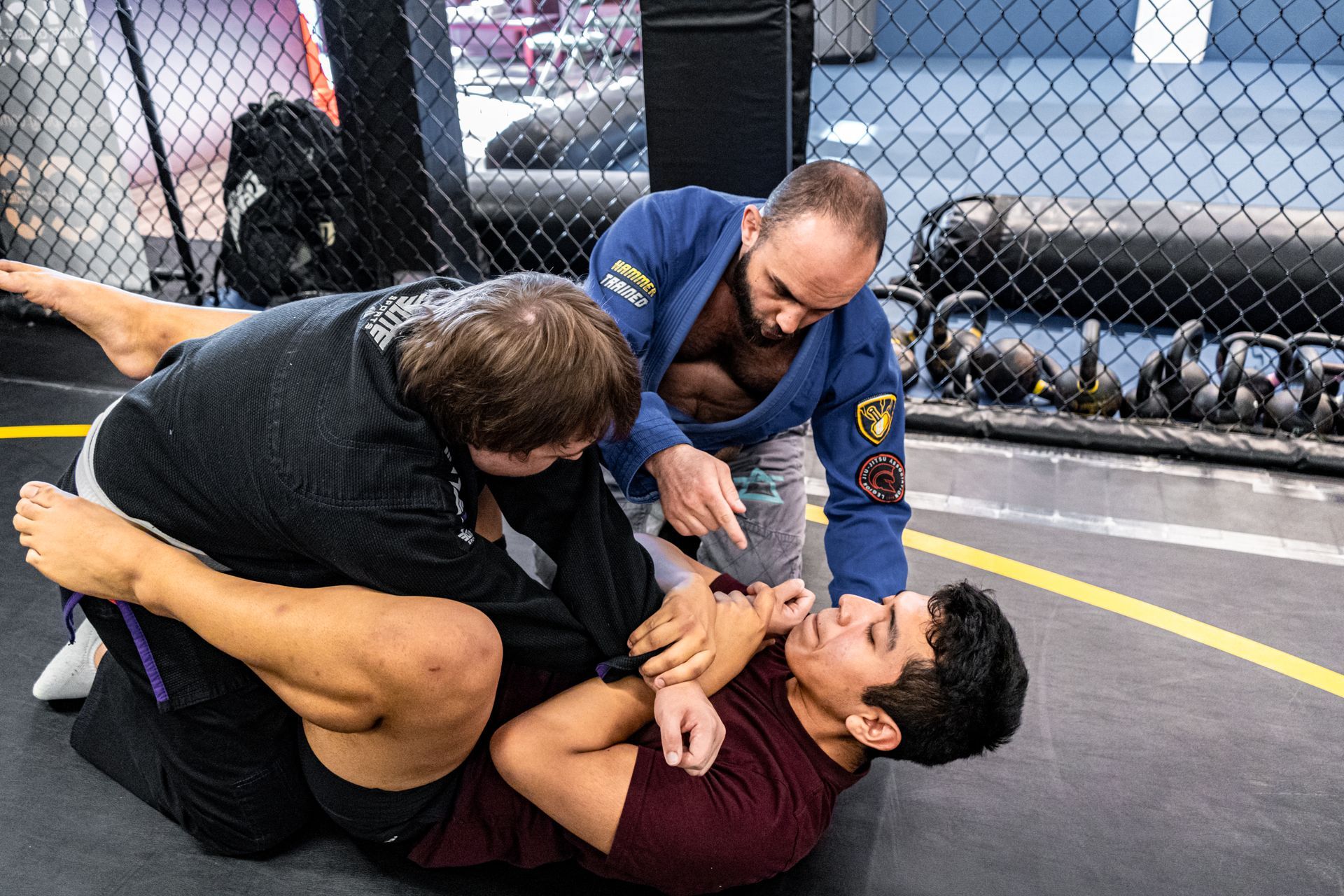
A typical first class starts with a warm-up that prepares your joints for grappling. You’ll practice fundamental movement patterns like hip escapes and technical stand-ups. Then we teach a small set of techniques, usually connected to one theme, so you’re not overwhelmed.
If there’s live training, we keep it controlled. New students don’t get thrown into a high-speed situation with no context. We want you leaving class thinking, “I can do this,” even if you’re tired.
Your first month: noticeable changes without needing perfection
By week two, most beginners feel their cardio improving. By week three or four, people usually start moving more naturally on the ground, especially in transitions like getting to their side, recovering guard, or standing up safely.
Here’s what we encourage you to focus on early:
- Show up consistently, even if you feel awkward at first
- Learn to breathe during effort, not only between rounds
- Prioritize position before submissions, because safety comes from control
- Tap early and often so your body stays healthy and your training stays long-term
- Ask questions, because clarity beats guessing
If your goal is Adult Jiu-Jitsu in Hazlet, NJ for endurance and mobility, the first month is where you build momentum. After that, progress becomes a lot more predictable because your body is adapting and your mind understands the basic map.
Gi vs No-Gi: what’s better for busy adults and self-defense?
You’ll hear a lot of opinions about gi and no-gi. We keep it simple and practical: both can be valuable, and the best choice depends on your goals, your schedule, and what style of training you enjoy enough to stick with.
Gi training adds gripping, friction, and slower positional battles. It can be great for learning control and technical detail. No-gi is typically faster paced, emphasizes clinching, body locks, underhooks, and quick transitions, and often feels more directly connected to modern athletic grappling.
For adults who want fitness, endurance, and practical movement skills, no-gi can be especially appealing. You’ll still learn leverage and control, but the pace tends to demand constant movement and steady cardio. If you’re curious about which format fits you best, the easiest answer is to try a class and feel the difference in your own body.
How often should you train each week to build endurance and mobility?
The best schedule is the one you can repeat. That said, most adults see real progress when they train 2 to 3 times per week. One day per week is a start, but it can feel like you’re always catching up. Four or more days can work too, as long as recovery is part of the plan.
A simple progression we recommend looks like this:
1. Weeks 1 to 2: 2 classes per week to learn fundamentals and let your joints adapt
2. Weeks 3 to 6: 3 classes per week if recovery feels good and your schedule allows
3. After week 6: adjust based on goals, with at least 1 full rest day weekly
4. Add optional light mobility work at home, 10 minutes a day goes a long way
5. If you feel run down, scale intensity before you skip training entirely
Adult Jiu-Jitsu rewards steady frequency more than occasional “hero weeks.” If you train a little, often, your endurance rises and your mobility improves without feeling like you’re constantly sore.
Safety, tapping, and training smart when you have an old injury
A lot of adults hesitate because of prior injuries or because they’re not 22 anymore. We get it. Our approach is to train in a way that supports longevity.
That starts with culture: tapping is normal, expected, and respected. You’re never “losing” by tapping. You’re communicating, protecting your joints, and staying in the game.
It also includes smart coaching choices. We scale intensity, match partners thoughtfully, and help you find modifications when something doesn’t feel right in your body. Many people can train safely with past knee, shoulder, or back issues, but it requires honesty, good communication, and a long-term mindset.
If you’re unsure, you can start slower. You can focus on positional rounds, controlled drilling, and building basic movement quality before pushing pace. Adult Jiu-Jitsu is not all-or-nothing.
What to wear to your first Adult Jiu-Jitsu class
If you’re trying Adult Jiu-Jitsu in Hazlet, NJ for the first time, don’t overthink gear. Start with clean, athletic clothing that lets you move. For no-gi, most beginners do well with a rash guard or fitted athletic shirt and grappling shorts or workout shorts without zippers.
A few practical notes that make your first class smoother:
- Trim your nails, it matters more than you’d think
- Bring water, you’ll use it
- Avoid jewelry, including rings and necklaces
- If you have long hair, tie it securely
- Show up a little early so we can get you oriented
We’ll handle the structure and pacing. Your job is to arrive ready to learn and willing to be a beginner for a while.
Pricing expectations and trying a class in Hazlet
Local directories and listings in the area suggest that jiu-jitsu memberships commonly land around $150 to $250 per month for unlimited training, and free trials are common. That range is typical for Adult Jiu-Jitsu programs because coaching is hands-on and classes require real instructor attention.
We aim to make starting simple and clear. If you want to train for endurance, mobility, self-defense, or just a healthier routine, beginning with an intro class is usually the best first step. It lets you experience the coaching style, the pace, and the environment before you commit to a schedule.
Because Hazlet is close-knit and busy, we also keep practicality in mind. A program only works if you can get to class regularly, and that’s why having training right here in town matters.
Take the Next Step
If you’re looking for Adult Jiu-Jitsu that improves endurance and mobility without requiring you to already be “fit,” we’ve built our training to meet you where you are and help you progress in a way that actually lasts. The goal is simple: move better, breathe better under pressure, and develop real skill that keeps your training interesting week after week.
When you’re ready to start Adult Jiu-Jitsu in Hazlet, NJ, we’ll help you get oriented, choose a sustainable weekly rhythm, and build confidence through fundamentals, no-gi grappling, and beginner-friendly coaching. At Hammer Sports and Performance, our job is to make your first steps feel clear, not intimidating, and to keep you improving long after the first month.
Build strength, improve your performance, and keep progressing with training at Hammer Sports and Performance.
